ABOUT US
Beijing Antaios Technology Co., Ltd. specializes in engine power solutions for small and medium‑sized construction machinery. With 10 years of expertise, we provide customized solutions and strict factory bench testing with complete test reports and traceable data to ensure reliable quality.
GET A FREE QUOTE

Precision-Matched Cummins 4BT Crate Engine Buying Guide: 9 Same-Fit Checks for Industrial Equipment
-
 author
 - 14,August
 author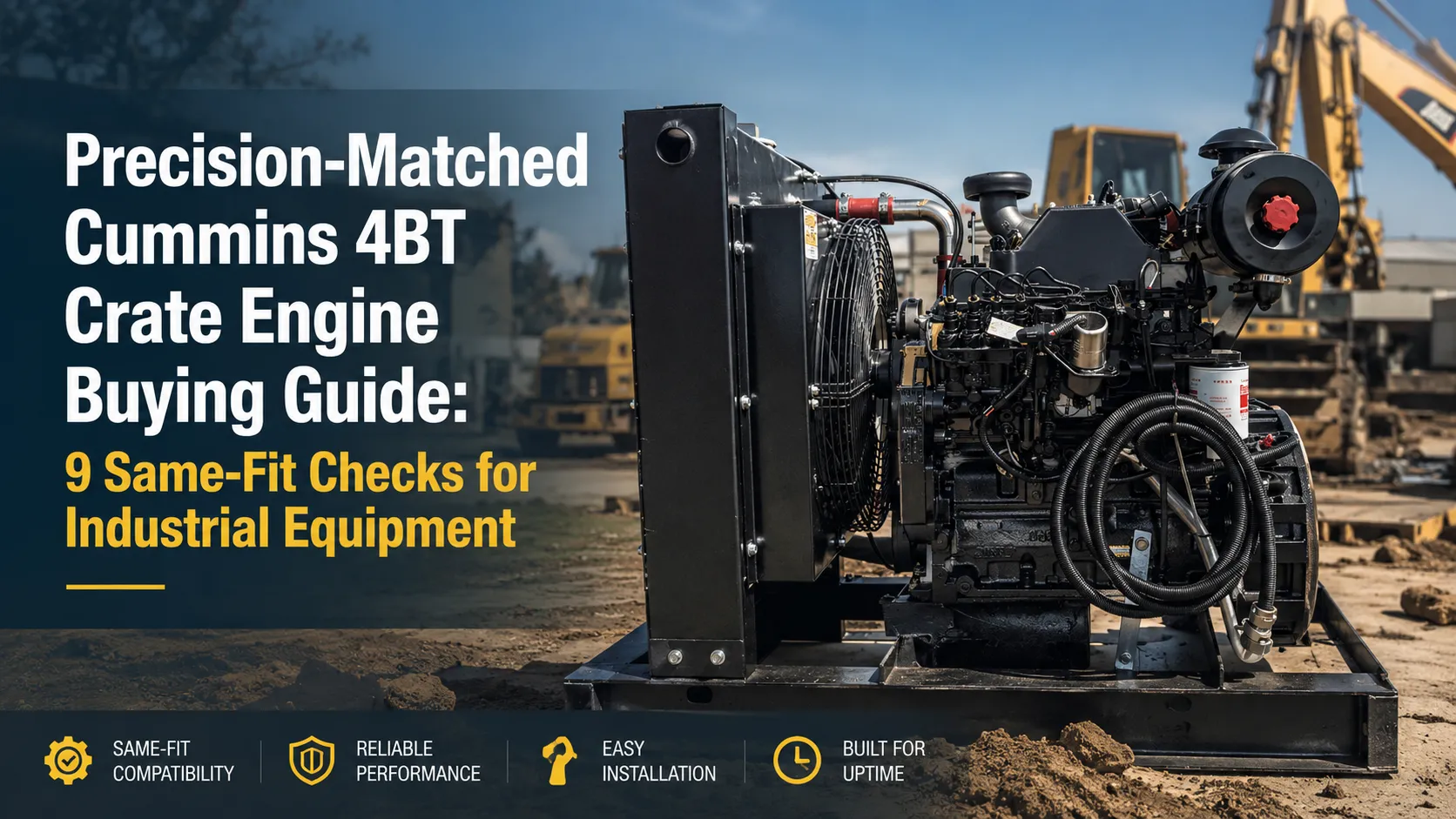
A Precision-Matched Cummins 4BT Crate Engine should arrive at your facility ready for installation on your machine, not in need of additional fabrication. Although the 3.9-liter 4BT appears to be a straightforward engine, differences in items such as gear ratio, torque output, flywheel size and style, flywheel housing size and style, and cooling system requirements, as well as various engine wiring configurations can rapidly turn what appears to be a simple installation into a frustrating and time-consuming rework project.
At ANTAIOS POWER, we build new diesel engine solutions around the equipment that will use them. Our engineers review output, duty cycle, drawings, interfaces, cooling, and working conditions before production. We confirm the configuration, test the completed engine, and prepare records that purchasing and engineering teams can use. Fewer assumptions. Clearer drawings. Less trouble at assembly.
Which Performance Checks Define Useful Output?
The model badge is only a starting point. Your equipment needs useful power at the correct speed and enough torque when load changes.
Check 1: Precision-Matched Cummins 4BT Crate Engine Power and Speed
Match the rating to real absorbed load, not the largest catalog number. A pump working steadily at 2,200 rpm differs from a compressor that cycles between loaded and unloaded states. Keep a sensible reserve, but avoid excess output that adds heat and cost.
Check 2: Torque Curve and Duty Cycle
Horsepower does not show how the engine responds when pressure rises or a hydraulic circuit asks for more flow. Check maximum torque, its speed point, and recovery after load change. Long shifts also differ from short repeated cycles.
Check 3: Aspiration and Speed Control

The 4B3.9 is naturally aspirated, the 4BT3.9 is turbocharged, and the 4BTA3.9 adds charge-air cooling. All use four inline cylinders, 3.9 liters, a 102 mm bore, and a 120 mm stroke. Similar block geometry does not mean identical system needs.
| Platform | Air System | Cylinders | Displacement | Bore × Stroke |
| 4B3.9 | Naturally aspirated | 4 inline | 3.9 L | 102 × 120 mm |
| 4BT3.9 | Turbocharged | 4 inline | 3.9 L | 102 × 120 mm |
| 4BTA3.9 | Turbocharged, charge-air cooled | 4 inline | 3.9 L | 102 × 120 mm |
Which Mechanical Checks Prevent Installation Rework?
Once output is right, the hard parts must line up. This is where a low purchase price becomes expensive.
Check 4: Envelope and Mounting Points
Confirm dimensions, weight, mount locations, oil-pan clearance, and service access. Fan, radiator, filters, and brackets may change the space requirement. Also check whether a technician can remove a filter without lifting the engine.
Check 5: Flywheel and Housing Interfaces
Verify flywheel size, housing standard, pilot diameter, bolt pattern, coupling depth, and rotation direction. An engine can fit the frame and still fail to connect. Put approved interface drawings into the technical agreement.
Check 6: PTO and Accessory Drives
Your hydraulic pump, compressor element, or auxiliary drive needs the correct flange, ratio, torque capacity, and position. “PTO available” is not enough. Ask for the exact arrangement and compare it with your drawing.
Which System Checks Protect Field Reliability?
A mechanically installed engine may still run hot, breathe poorly, or send the wrong signal to the control panel.
Check 7: Cooling Capacity and Airflow
Review radiator capacity, fan diameter and direction, shroud clearance, coolant routing, and hot-air recirculation. Heat, dust, altitude, and enclosed compartments reduce cooling margin. A compact bay looks tidy; a bay that releases heat works better.
Check 8: Intake, Exhaust, and Fuel Routing
Check air-filter capacity, intake restriction, exhaust back pressure, outlet direction, and fuel filtration. Keep hot parts away from wiring and hoses. At dusty sites, easy air-cleaner access matters almost as much as filter size.
Check 9: Voltage, Sensors, and Controls
Confirm 12 V or 24 V starting, charging output, shutdown logic, speed signal, senders, harness length, and connector type. Mechanical and electronic speed control need different panel logic. One wrong plug can hold up a finished machine.
For a Precision-Matched Cummins 4BT Crate Engine, all nine checks should be approved as one system review, not handled after arrival.
What Evidence Should You Require before Shipment?
A specification selects the engine. Test records prove what was built. Both matter for the first unit in a new machine program.
Written Technical Agreement
List the model, rating, interfaces, mounts, cooling scope, intake and exhaust positions, electrical system, accessories, and test points. Attach approved drawings so every team uses one version.
Bench-Test Data
A useful test includes preparation, warm-up, staged loading, data recording, leakage checks, and a report. ANTAIOS POWER describes an eight-step process using a dynamometer, calibrated sensors, live monitoring, and post-test inspection. Its wider workflow can cover more than 30 test items.
Unit-Linked Inspection Records
Each engine is supported by an individual, traceable inspection record linked to its Engine Serial Number (ESN), with the performance test report, actual engine photos, configuration list, and packing record matched to the same unit. In addition to the running video, performance under rated load can be verified through the corresponding test report, while accessories and engine configuration can be checked against the configuration list and actual unit records. This provides clear traceability for each engine from testing and configuration through to packing.
Why Work with ANTAIOS POWER on a New Equipment Project?
The final choice is also about who checks awkward details before your production line finds them.
Application-Based Selection
Through our company experience, we support new construction and industrial equipment projects with technical matching rather than model-only selling. We review power, speed, interfaces, working conditions, and batch consistency before production.
Controlled Testing and Delivery
Our technical service process connects requirement collection, engineering review, manufacturing, bench testing, inspection, and delivery documents. Your team gets a clear approval path and a reference configuration for later units.
Direct Project Review
Send your load calculation, speed, peak load, duty cycle, installation drawing, cooling plan, voltage, quantity, and target date through the ANTAIOS POWER contact team. A complete input package saves several rounds of email, which nobody misses.
Conclusion
A Precision-Matched Cummins 4BT Crate Engine is not defined by displacement alone. It is defined by power at the right speed, usable torque, matching interfaces, workable cooling, correct controls, and test evidence tied to the shipped unit. Check those points before production, and your new equipment project reaches commissioning with fewer surprises.
FAQ
Is the highest horsepower model always best?
No. ANTAIOS POWER matches the engine to load, speed, torque, cooling capacity, and driven-unit limits. Extra horsepower may add heat and cost without adding useful work.
What should be sent before model selection?
ANTAIOS POWER recommends equipment type, load calculation, normal and peak speed, duty cycle, layout drawing, interface details, cooling plan, voltage, quantity, and delivery target.
What proof should arrive with the engine?
For a Precision-Matched Cummins 4BT Crate Engine, ANTAIOS POWER can provide agreed technical documents, unit-linked inspection records, bench-test data, photos, and shipping records within the confirmed project scope.
Recent Post




Related Products
Best-selling Products

912/W Series
The 912 series engine is an air-cooled diesel engine with a power range of 14-76 kW and a speed range of 1500-2500 rpm. This series of engines offers a variety of 2, 3, 4, and 6-cylinder options.
The 912W series is an upgraded version of the 912 series. To better suit the underground mining working environment, the 912W series features improved engine emissions.
Over the past decade, ANTAIOS' 912 series diesel engines have been exported to more than 100 countries. This product is mainly used in construction machinery, industrial and agricultural fields.

914 Series
The 914 series diesel engine is commonly used in underground mining environments. This air-cooled engine has a power range of 41-141 kW and a speed range of 1500-2500 rpm. It is available in both naturally aspirated and turbocharged versions to meet your different needs.
Unlike most 914 series engines produced in Chinese factories, ANTAIOS provides genuine German parts for its 914 series engines. This ensures engine quality while offering you a lower price than European brands.

2012 Series
The 2012 series engines are water-cooled engines manufactured by DEUTZ of Germany. This engine series is widely used in the fields of construction and generation. Available in both 4-cylinder and 6-cylinder configurations, common models include the BF4M2012, BF4M2012C, and BF6M2012C. If your equipment is powered by a DEUTZ 2012 series engine, ANTAIOS can provide you with suitable replacement solutions.
Our 2012 series diesel engines cover a power range of 75–155 kW, with speeds reaching 1500–2500 rpm. If you have customized requirements, we can also provide optional configurations, such as the cooling system, tailored to your specific needs

TCD2012/2013 Series
The TCD2012/2013 series is a high-pressure common rail, water-cooled diesel engine. Compared with the standard versions, this engine offers higher emission standards, making it more suitable for applications with stricter emission requirements. In past equipment applications, it has been widely used in underground mining operations.
The TCD2012/2013 series engines supplied by ANTAIOS typically have a delivery time of about one month. If the configuration requirements are relatively simple, the delivery time can sometimes be shortened to around 10 days. Since the TCD2012 series engines provided by ANTAIOS are custom-built, they are not kept in stock. All engines are scheduled for production after your order is placed.

1015 Series
The DEUTZ 1015 series engine is a large water-cooled engine, available in both 6-cylinder and 8-cylinder configurations. Unlike DEUTZ’s other 4-cylinder or 6-cylinder water-cooled engines, this engine features a V-type cylinder arrangement, significantly reducing the space required for installation.
The BFM1015 engines supplied by ANTAIOS are produced by reputable manufacturers in China. These engines are typically used in specialized equipment, where performance requirements are more demanding. Before delivery, each engine undergoes bench testing in accordance with original factory standards, along with additional testing based on specific requirements, to ensure that the engine we provide fully meets your application needs.

TCD2015 Series
The TCD2015 series engine is a V-type, 4-stroke, water-cooled diesel engine. This engine is available in V6 and V8 models, with power outputs ranging from 240-500 kW and a common operating speed of 2100 rpm. It meets Euro III emission standards and above. This engine is widely used in construction machinery, generator sets, mining equipment, marine power, and oil and gas equipment.
In addition to customizable configurations, ANTAIOS also offers custom paint colors. Unless otherwise specified, we generally offer gray paint.